Solar SOLAR PANELS ? IN SERIES OR IN PARALLEL ?

Hitting the road

Well-Known Member
Jan 14, 2022
320
417
63
Brisbane
I have always been the opposite...more volts to push the amps. I am certainly no expert, but the issue I have read of over and over, is that a 12v Lithium battery needs around 14.2 to 14.6 volts input to ensure proper charging.
Most solar panels here are 18v output, so in when the sun is low in the sky an 18v panel will easily fall to less than 14v output which can curb the actual charge to the battery...that effectively reduces the hours in a day, especially during winter in Oz, where a solar panel will send enough voltage to put charge back in to a battery. It could be as little as 3 - 4 hours in the day depending where you are.

Hence I have always wired my panels in series, with 2 x 18v output panels I can get up to 36v in full sunshine, and even as the sun lowers in the sky I will still be getting at least 20v to the MPPT sending charge to the battery. I see effective charge going to the batteries as early as 9am in winter, and still going to after 3pm.
Cloudy days do make a huge difference to input, but I still get a good charge going in most of the day as sun peeps out from time to time.

The panels I have on the roof now are the new "twin cell" type panels rated at 20.6v output...so they apparently can still send effective charge if partially shaded due to the split cell arrangement...(basically each single panel is split in to 2 panels, 50 - 50), in ideal conditions can send around 40v to the MPPT...I have noted an ok voltage to the MPPT even if one of the panels is partially shaded.
If I put out the portable panels I have it can add another 36v to the MPPT input if required...I would have put 3 panels on the roof but just no space.

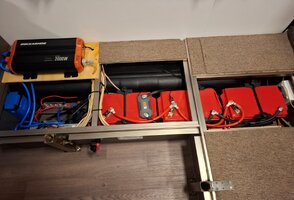
With the 400amps, or 4800w of battery storage I have, the 2 x 200w panels on the roof are really insufficient...but...I have found pumping the up to 40v in I can still recharge the batteries after a previous day of using the inverter to run a coffee machine, boil the kettle, run a hair dryer, as well as the usual night time lighting, TV, phone charging etc.

I always try to find a sunny camp site anyway, if I get a shady spot, and cloud cover as I did at Mount Beauty in the High Country a few months ago, putting out the portable panels...in series...had batteries back to full by just after mid day as the roof panels were still sending some intermittent charge. In stinking days I can opt for shade and use the portable panels out in the sun with good effect.
The MPPT I have has a max of 80v input or 450w.

The argument I guess for parallel over series is a personal preference...yes series makes for one big solar panel so any shaded part of one panel will affect the whole output...parallel can have a shaded panel and the remaining panel or panels will still send some charge.
 
Last edited:
  • Like
Reactions: poor but proud

Drover

Well-Known Member
Nov 7, 2013
13,256
20,064
113
QLD
The charge voltage for Lithium or AGM is really very similar but that rate is from the controller to the battery and its the controller that regulates the charge voltage, what is coming from the panels has nothing to do with it ...
Thing I can't get around is that 2 x 200w panels in Series only supply about a quarter of the Amps that 2 x 200w panels in parallel supply ............ and its all about the amps, or so I thought ............ if a large cable run like on a house , well yes series is understandable the cable size doing parallel would be huge or great losses occur but on a RV I just don;t see it being an issue with short distance ............................. Does my head in actually ..................................
On some cloudy days mine will be shunting high amps at 16v ..........
Irrelevant really as the 120w portable can push out 7a if lined up properly and have things back in float before the roof tops even start to do any sort of hard work, its placed near vertical for the morning and arvo sun, so it does the hard yards in the off hours when flat roofs are not much chop ..
If it all well works its good if it doesn't then upgrade ........... we should do a comparo one day, nothing like a real world experiment.

Been contemplating having my coffee machine when away, have to upgrade the invertor of course but sick of plunger coffee, have to work out how much juice mine demands..................

Amps = Watts/Volts
 
Last edited:
  • Like
Reactions: poor but proud

poor but proud

Well-Known Member
Aug 25, 2018
513
697
93
75
redlands
i am taking all this onboard,the days of simple things are over,except me that appears, i can see Drover sitting beside a river sipping his coffee machine soy latte watching his electric fishing reel on his powered massage chair under his sun tracking umberella thinking about using his battery pack vac to clear away any prickles,ahhh the modern world
 

Drover

Well-Known Member
Nov 7, 2013
13,256
20,064
113
QLD
i am taking all this onboard,the days of simple things are over,except me that appears, i can see Drover sitting beside a river sipping his coffee machine soy latte watching his electric fishing reel on his powered massage chair under his sun tracking umberella thinking about using his battery pack vac to clear away any prickles,ahhh the modern world


Thats pretty close to real thing except no soy latte swill for this fella, long black thank you, maybe a dash of milk at times, electric fishing reel is a possibility it might do a better job than me, I wear an Akubra , cordless vac is real though by most rivers I need my brush cutter for the mongrel things, the massage chair is real we have 2, the single seat lay back arm chairs I fitted inside actually have a 12v massage capability plus just lift up to take outside and so long as I don't fall down the step its all good .......................

But on the electric side , its either, either, depends on so many variables ................. if you have loss from panels to controller then Series would be the way to go as the original van wiring is more than likely too light/long, so you need more Volts to push the Amps along, doing a new run of cable is not often easy aftermarket, Big Mal had no loss, well .0* so can stay Parallel and keep the higher run of Amps to batteries and shadow from AC isn't a big issue then ......

Good example of cable size being the big issue was in my shed, my 200w 36/46v house panel had major loss when I first set it up as I didn't have heavy enough cable available when I did a proof of concept, once I did a run of 8 B&S , bugga all loss over the 5 mt run so then just ran some 40a cable from controller to boat battery which showed no loss on that run ............... As in most things people forget that the cable and connections are very important and often cause the most problems and major upgrades to panels not needed if the ground work is done properly................
 
  • Like
Reactions: Hitting the road

Hitting the road

Well-Known Member
Jan 14, 2022
320
417
63
Brisbane
This will do your head in...I was watching a You Tube video the other day, an Electrician talking about battery size, amps, voltage, watts etc. His thought is we should be using Wattage as the measure, not Amps, as 12v, 24v and 48v will all have similar characteristics once in the system, but use / demand different Amperage's, so to refer to out put or use in Wattage is simpler...apparently

Being he noted, Solar panels are usually measured in Watts output, while Battery capacity is generally measured in Amp Hours...a Battery charges output is generally measured in Amps...while Inverters are measured in max Watts output, while most appliances refer to their Wattage, not Amperage in use. But try talking Watts instead of Amps and one can get a tad confused...

I mentioned that in my post above, I have 4800 Watts of battery capacity, which, in theory is more reliable description when working out how much a 4800w battery would last running a 2000w Inverter. So to add to confusion, this is what AI gives as a reply to question, how long would a 2000w inverter run at capacity from a 4800w battery;

"To estimate how long a 12V 2000W inverter can operate with a battery providing 4800W, you need to consider the battery capacity in amp-hours (Ah) rather than just watts. If the battery is rated at 4800W, it would typically provide around 400Ah at 12V, allowing the inverter to run for approximately 2 hours at full load (2000W), assuming no losses"

So...though the Inverter is sold and rated in watts, the easiest way to calculate the time line apparently is to use battery capacity in Amps?

Anyway...the reason I decided to go series in all my panels was mostly to do with the distance from the panels to the solar controller. High voltage does not require the same thicker gauge wire as Amps require, therefore theoretically less Voltage loss as opposed to Amp loss.

The run from the solar panels on the roof of my van to the MPPT is easily 6 metres, maybe even 7 with the twists and turns to get from the MPPT to the array output on the roof at the front of the van.
Same with the portable panels, from where the MPPT is, it would be 6 metres to the Anderson plug at the drawbar, then add another 5 metres to the solar panel array. Thats 11 metres of cable run...I do use 8 awg cable for external solar, but it looks like the original internal cabling on the van might be 12 awg at most....which would be fine for the 36v I can get from the roof panels with little loss. The original panel fitment was a single 160w, 18v, 7.5 Amp job. I did measure the output to the MPPT from the single panel and remember the best I ever got was 5 amps...straight off the panel itself was 7.5 ish amps.

But as you note Drover...it would be an interesting excercise to compare hour by hour inputs through parallel or series...
 
  • Like
Reactions: Drover

Drover

Well-Known Member
Nov 7, 2013
13,256
20,064
113
QLD
Glad to share the pain, I went down the watts conversion to amps and "Micky Verta" ages ago when I was working things out and came to the conclusion like in many of these things it all depends on the set up, just like suspension etc, there is no right way just the best for your situation ..........

Back in the B&W days when I transitioned from Tilly light and Esky to the magic of 12v fridge and a converted tail light for out bush, it was simple, the borrowed truck battery lasted 3 days if lucky, of course things progressed, extra light meant more power needed and then there was summer, a Victa Toe Cutter motor plus a Holden Alternator, married together in a frame meant the battery life was extended, albiet to others annoyance until they discovered it could charge their batteries as well and so it all evolved to the massive power plants we have now, the downside now just like driving no need to know what your on about just go to Kings and buy the set up .............. Some don't know the fun they are missing ..............

I have toyed with the ideaa of pulling mine off, clean up and re position them but then looked at it and went nah, leave well enough alone........... and now i have another important job to do that I will muse about elsewhere................